
Why choosing is harder than it looks
Most services let you judge the result with your own eyes. A painted wall looks painted. A mowed lawn looks mowed. Duct cleaning is different, because the dirty surface and the clean surface are both hidden. You are asked to pay for something you cannot easily verify, and that gap is where problems start. A provider can do excellent work or poor work and the house looks the same from the living room.
That is why the choice rests on process rather than appearance. A careful provider makes the invisible visible: photographs of the inside of the system before work, an explanation of what was found, a described method, and photographs afterward. A rushed provider skips these steps because they take time and invite questions. You will not always be able to judge the quality of the brushing or the vacuum, but you can judge whether the company is open about what it does.
The second reason choosing is hard is that the phrase duct cleaning covers a range of work. It can mean a quick pass at the registers, a vacuum of the main trunk lines, or a full system cleaning that includes the air handler, the coil face, the blower compartment and every branch. Two quotes that look similar may describe very different jobs. Part of choosing well is getting the scope clear enough that the quotes can actually be compared.

Finally, the right answer is sometimes no cleaning at all. A provider who inspects and tells you the system is in reasonable condition is serving you well, even though they gave up a sale. That honesty is the single best sign you can look for.
Look for evidence first, before any recommendation
The most important habit of a careful provider is that evidence comes before the recommendation. They look, they photograph, they show you, and only then do they say what they think should happen. The order matters. A company that tells you on the phone that your ducts must be cleaned, before anyone has looked inside, is selling a conclusion it has no basis for.
On the phone, a careful provider will ask about the home and the symptoms, and will usually say that an inspection is the sensible first step. When the technician arrives, expect an inspection with a light and, where needed, a camera. Expect photos of the air handler, the coil, the blower compartment, the accessible trunk and a sample of branch ducts. Expect the technician to hold the phone or tablet so you can see what they see.
Ask what the evidence would have to show for cleaning to be recommended. A good answer names conditions: visible debris buildup that restricts airflow, water damage, pest evidence, construction dust inside the system, or a dirty blower or coil that affects performance. A weak answer is vague, such as that ducts get dirty over time and need cleaning every so often. Our page on the duct cleaning evidence checklist lists the specific things worth looking for.
Be especially cautious of any claim about what is in your air that is not backed by a test or a photograph. Statements like your ducts are full of mold, said without showing a visible reason, are a pressure tactic. Our page on visible mold versus dust explains why identifying a substance by eye alone is not reliable.
Ask how the cleaning is actually done
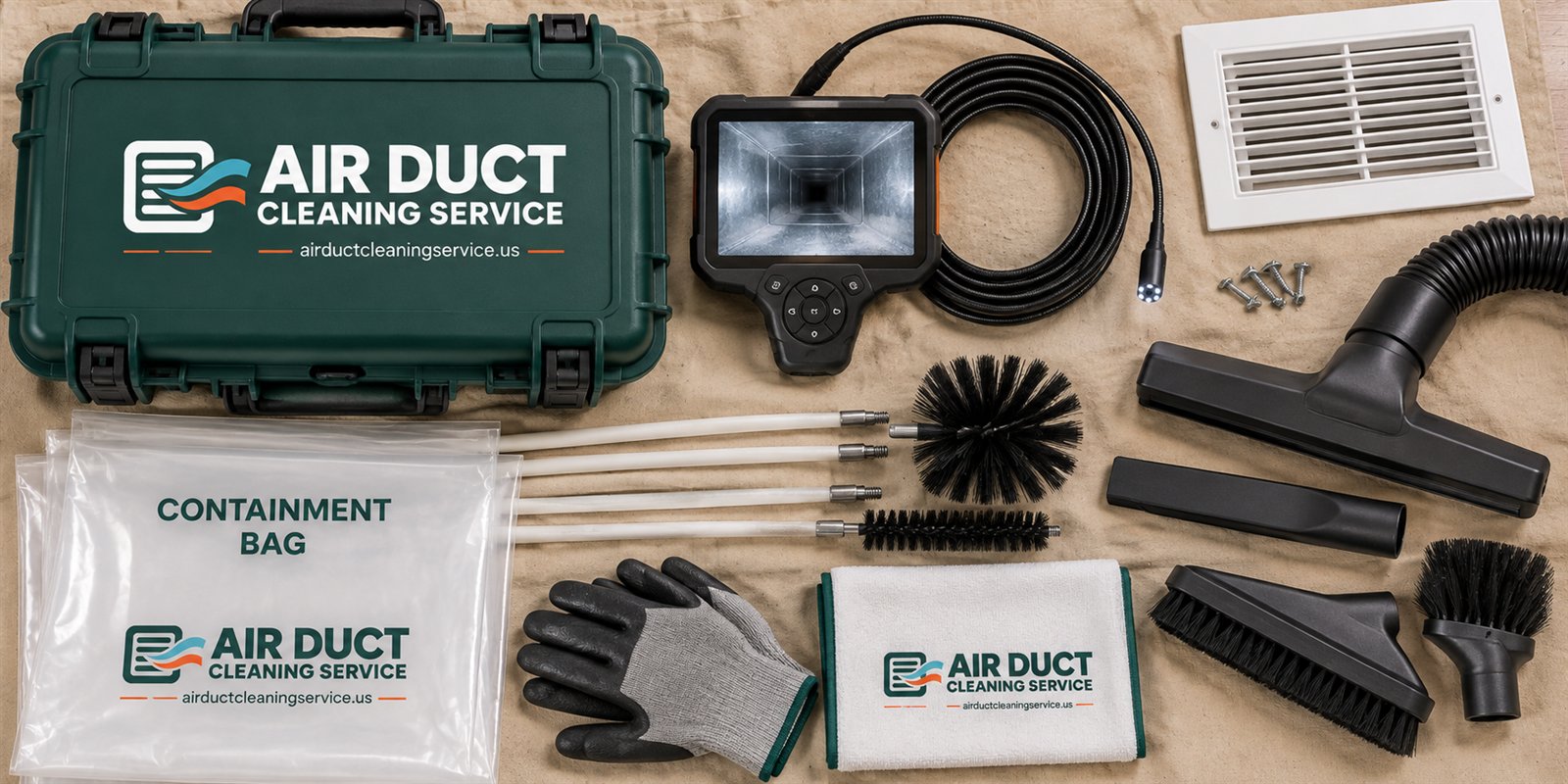
A provider should be able to explain their method in plain language. In a proper cleaning, the system is put under negative pressure by a powerful vacuum collector connected to the duct, so loosened debris is pulled out of the building instead of blown around. Agitation tools such as brushes, air whips or compressed air nozzles loosen what is stuck to the surfaces. The order matters too: the work moves toward the collector so that dislodged material is carried away.
Ask whether the whole system is included, and which parts. The registers and grilles, the supply branches, the trunk lines, the return, the plenums, the blower compartment and the coil all hold or move air, and not all of them are cleaned in every job. A quote that names the parts is more useful than one that says whole house. Our pages on brush and air whip methods and on the negative air machine explain the equipment.
Ask how access to the ducts is made. Technicians often open existing panels or cut small openings in trunk lines, and those openings must be closed and sealed properly afterward. Ask what material is used to close them and whether you will be shown the result. A sloppy closure is a leak, and a leak in a duct wastes cooled air and can pull in attic dust.
Ask what the provider does about flex duct, which is common in Florida homes. Flex duct has a thin inner liner that can be damaged by aggressive tools, so the method has to be gentle enough to avoid tears. A provider who has not thought about this is likely to cause damage. Our page on flex duct in Florida homes explains what makes it different.
Check credentials, insurance and paperwork yourself
Do not rely on a logo or a claim in an advertisement. Ask the company to tell you what credentials and insurance it holds, and verify what you can through the sources that issue them. Contractor and business registration in Florida can be checked through the state and the county, and certificates of insurance can be requested and confirmed with the insurer. A company that is comfortable with verification will give you the information without friction.
Be aware that duct cleaning itself may not require a specific state trade license in every situation, while related work such as modifying or repairing HVAC equipment generally does require a qualified contractor. If the provider proposes anything beyond cleaning, such as replacing a section of duct, changing a coil or sealing leaks in a way that modifies the system, ask who will do that work and under what authority. Our page on verifying credentials and insurance lists practical steps.
Industry organizations publish cleanliness and procedural standards that careful providers follow or reference. A provider can say they work to a published standard, and you can ask them to show you the standard and explain how they apply it. Our page on cleanliness verification explains what that kind of check looks like in practice. Claiming a standard is easy; being able to describe it is the test.
Finally, ask for the paperwork in advance: the written scope, the terms, and what the report will contain. Read it before you agree. If the company will not put the scope in writing, treat that as a reason to look elsewhere.
How a careful provider talks about price
Price is the topic where conduct shows most clearly. A careful provider asks scope questions first: how many air handlers, how many returns and supplies, what kind of ducts, whether there is a history of water, pests or renovation. A price that is stated before those questions are answered is a guess dressed as a fact, and it tends to change once the technician arrives.
Beware of numbers that sound too good to be true, and of a price that applies to everything in the house for one small figure. Cleaning a whole system properly takes time and equipment. A very low quote often means a partial job, with the real price arriving as add-ons once the technician is on site. Our page on the red flags in duct cleaning offers describes those patterns in detail.
On this site, quotes are given only by phone, after the questions are asked. A complicated job may need an on-site visit first, and there is a service call charge for that visit, explained on the phone before anyone is dispatched. Our pages on why quotes are given by phone and the service call charge explain the reasoning.
Whatever provider you consider, ask what is included, what is not included, and what would change the price. A good answer is specific. If they say that nothing would change it, ask what happens if the technician finds something unexpected, such as a collapsed duct or a section with water damage. The answer shows whether the quote was built on the evidence or on a hope.
Signs of respectful conduct on the day
Conduct on the day is something you can observe directly. A careful crew arrives, introduces themselves, explains what they will do, and asks where the air handler and the access points are. They protect floors and furniture near the work area, they set up equipment in a sensible place, and they keep you informed as they go.
They also do not rush you. If the inspection shows something you did not expect, they stop and show you rather than pressing for an immediate decision. They explain the options in plain English, including the option of doing less or nothing. They do not suggest that a decision must be made right now or that the price will change if you wait until tomorrow.
Watch how they handle the photographs. A technician who photographs before, during and after, labels the photos by location, and sends them to you later is building a record. A technician who takes a few pictures of the dirtiest spot and none of the rest is building a sales slide. Our page on what happens on the phone call and our guide to reading before and after photos will help you judge what you are shown.
Pay attention to how they speak about their competitors and about your system. Respectful providers describe what they see without insulting the previous installer or the homeowner. They explain conditions as conditions, not as failures. That tone tends to correlate with the quality of the work.
Claims a careful provider will not make
Some statements are reliable warning signs. A careful provider will not say that duct cleaning cures asthma, allergies or any illness. They will not say it always improves air quality, because the effect depends on what is inside the system and what is happening elsewhere in the house. They will not say that ducts must be cleaned on a fixed schedule, because the evidence does not support one schedule for all homes.
They also will not claim that a spray or fog will permanently prevent growth, or that a single treatment makes the system safe for good. Moisture is the main driver of growth, and an application does not change the moisture conditions that caused it. A provider who treats a treatment as a substitute for fixing a leak or a drain problem is not looking at the cause.
A third category is statements about promised outcomes. No one can promise that dust will not return, that odors will vanish, or that a particular symptom will improve. A careful provider can describe what they will do, what they will document and what they expect to see, and can say honestly that results vary with the home. Our page on common duct cleaning myths sorts out the claims that overreach from the ones that hold up.
If you hear any of these claims, you do not have to argue. You can simply say that you would like to see the evidence first and make the decision afterward. A careful provider will agree. A pushy one will reveal itself by the response.
A short checklist to use when comparing providers
No provider will be perfect on every line, and a missing item is a reason to ask a question, not an automatic disqualification. What you are looking for is a pattern of openness. When most items are a clear yes, you are probably working with a careful company. When several are a vague answer or a change of subject, take your time and keep looking.
It also helps to talk to two providers rather than one. The comparison itself is informative, because you will hear which questions each one asks and which each one avoids. Do not choose on price alone, because two quotes for different scopes are not comparable, but do note which provider helped you understand the job.
- Did they ask about your home and symptoms before naming a price or a scope?
- Do they inspect first, and will they show you photographs of what they found?
- Can they explain their method, including the vacuum collection and how access openings are closed?
- Is the scope, including each part of the system, put in writing before work begins?
- Can they tell you what credentials and insurance they hold, and are they willing to be verified?
- Do they avoid health claims, fixed schedules and pressure to decide on the spot?
- Will they provide before and after photos and a written summary of the work?
- Do they explain the service call charge and when it applies before they dispatch anyone?
Making the call
When you are ready, call and describe what is going on: the type of home, the number of air handlers if you know, any smell, stain, pest sign or recent renovation, and what you hope to learn. Expect questions in return, and expect the provider to explain the inspection step and what happens next. If an on-site visit is advised, the service call charge is explained before dispatch, so there is no surprise.
Have your own notes ready, including the filter size, the last time it was changed, and any photographs you have taken of registers or the air handler closet. Do not worry if you do not know the technical terms. Plain descriptions are fine, and a good provider will translate.
Choosing a duct cleaner comes down to whether the company treats your home and your decision with respect. If the answers you hear are specific, evidence-based and calm, you are in good hands. Call when you are ready, and we will talk through your system and the sensible next step.
Questions people ask
What is the most important sign of a trustworthy duct cleaner?
Evidence before recommendation. A trustworthy provider inspects, photographs the inside of the system, shows you what was found and then explains what they suggest, including the option of doing nothing. They put the scope in writing and do not pressure you to decide on the spot. A company that names a conclusion before looking is worth questioning.
Should I choose the provider with the smallest quote?
Not on price alone. Two quotes may describe very different scopes, and a very low number often means a partial job with add-ons later. Compare what each includes: which parts of the system, what method, what documentation. The provider who explains the scope clearly and shows evidence is usually the better choice.
How can I verify a company's credentials and insurance?
Ask the company what it holds, then verify through the issuing sources. State and county records can confirm business and contractor registration, and you can request a certificate of insurance and confirm it with the insurer. If any work goes beyond cleaning, such as modifying equipment, ask who will perform it and under what authority.
Is it normal for a provider to refuse to quote without asking questions?
Yes, and it is a good sign. Scope questions come first because the number of air handlers, duct type and any history of water or pests change the work. Quotes here are given by phone only, and a complicated job may need an on-site visit with a service call charge explained before dispatch.
What should I do if a technician claims my ducts are full of mold?
Ask to see it. A claim like that should come with photographs of a visible reason, and a recommendation to confirm with proper testing if there is real concern. Visual inspection alone cannot identify a substance. You do not have to decide immediately; take the photos, ask for a written report and consider a second opinion.
Can I ask for before and after photos?
Yes, and you should. A careful provider photographs the same locations before and after, labels them and sends them with a written summary. Photos of only the dirtiest spot are not enough. If the company resists documentation, treat that as a reason to keep looking. Call to ask how documentation is handled.
Describe the situation by phone and we will tell you what the job involves. Quotes are given by phone. Jobs that cannot be quoted without seeing them need a technician on site, and the service call charge is explained on the phone before anyone is dispatched.
Related pages
- Red Flags: Pressure tactics, vague scope and claims that go beyond the evidence: the warning signs to spot in a duct cleaning offer before you hire anyone.
- Second Opinion: How to compare scope, evidence and methods between two duct cleaning providers, and when it makes sense to ask for a second opinion before you agree.
- How Inspection Works: Follow an air duct inspection from the front door to the written findings: what is checked, what is photographed and what you should be shown before any work.
- Myths: A sorted list of duct cleaning claims that overreach, claims that are reasonable, and how to tell the difference using evidence from your own system.
- Dryer Vent Reroute: When a long or bent dryer vent run justifies a new path, what evidence points to rerouting, and why the work should be done by someone qualified.
- Seal First: The order of duct repair, sealing and cleaning, and why it matters: leaks that feed dust, work that stirs it up and how to sequence jobs in a Florida home.