
What this service is, and what it is not
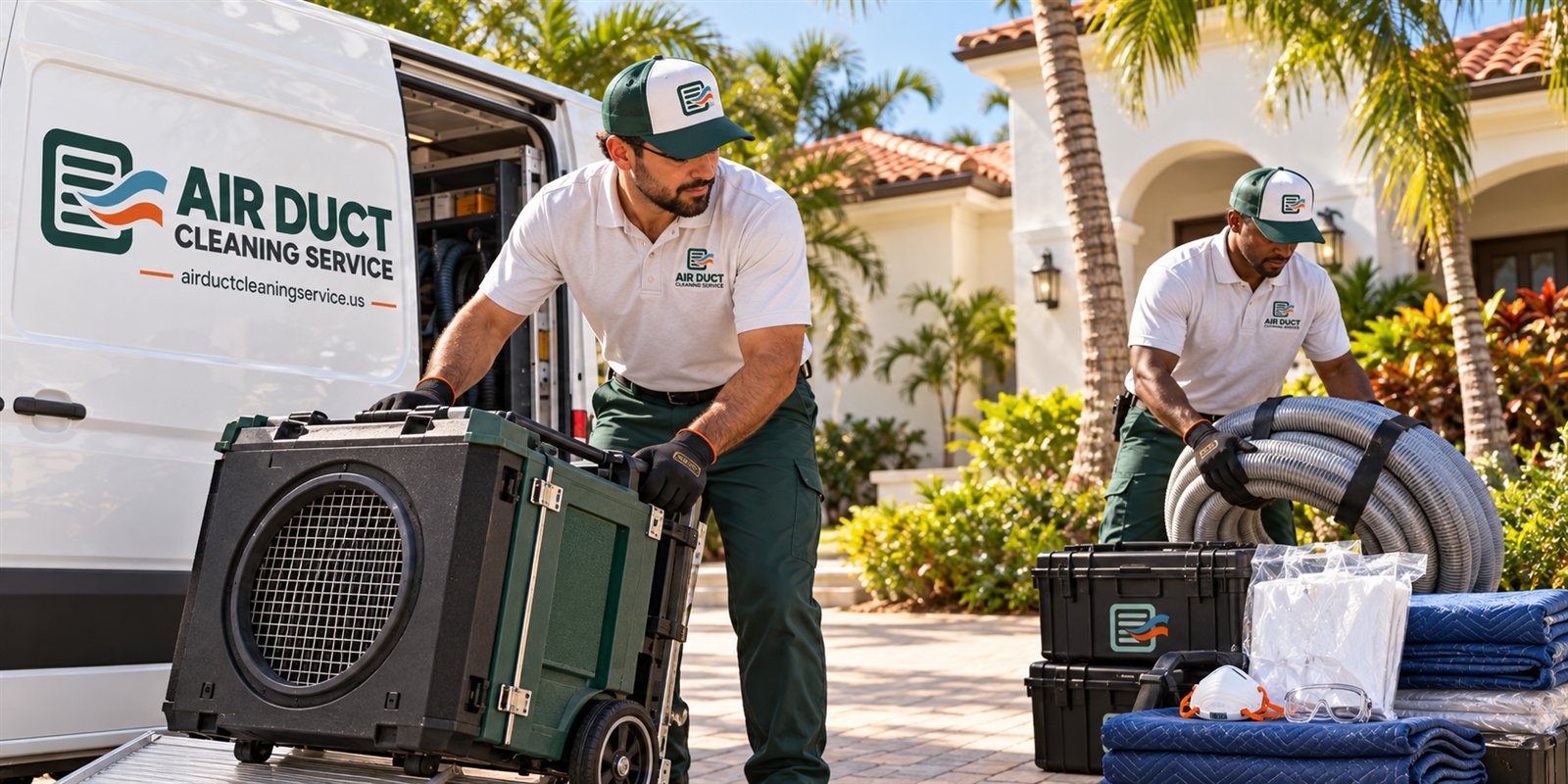
Air duct cleaning means removing built-up dust, debris and residue from the parts of a central air system that move air through your property. That includes the supply ducts that deliver cooled air, the return ducts that pull air back to the equipment, the registers and grilles you see on walls, ceilings and floors, and the blower compartment inside the air handler. It is a mechanical cleaning job, done with agitation tools and strong negative-pressure vacuum equipment, and it is a different trade from air conditioning repair. You can read the full list of offerings on our services hub.
What it is not matters just as much. Cleaning ducts does not cure an illness, it does not guarantee that the air in your home will be better, and it does not need to happen on a fixed calendar. Some homes have ducts that are quite clean after many years. Others have a clear, visible problem after a single renovation or a leaking roof. The only honest way to tell the difference is to look. That is why this whole site is built around inspection first, and why we would rather tell you a cleaning is not justified than sell you one that is not.
South Florida adds its own wrinkles. Air conditioners here run most of the year, humidity is high, storms bring water and debris, and a great deal of local housing uses flexible duct in an attic. Those facts change what gets dirty, what can be cleaned safely and what is better repaired or replaced. The pages linked throughout this overview go into each topic in more depth, and the guides hub collects the practical reading for owners, managers and buyers in one place.

When duct cleaning is justified
A cleaning is justified when there is evidence that the duct system itself is carrying a problem that cleaning can remove. The clearest cases are physical and visible. Examples include heavy dust or debris you can see on the inside of a duct or on the blower wheel, a camera image showing a thick layer of material on the duct walls, droppings or nesting material from rodents or insects, and construction dust that was pulled into the system during a remodel. After a flood, a roof leak or a hurricane, wet or contaminated ducts also call for careful evaluation. See cleaning after construction and duct concerns after a hurricane for how those situations are handled.
Other situations are reasonable but less urgent. Moving into a home with unknown history, preparing a rental unit for a new tenant, or buying a property where the seller cannot say when the system was last opened up are all good moments to look. Our move-in cleaning and rental turnover pages describe what an owner can sensibly ask for in those cases.
- Visible debris, dust buildup or residue inside supply or return ducts
- Evidence of pests, droppings or nesting material in the duct path
- Dust and debris after renovation, drywall work or roof replacement
- Water entry from storms, flooding or a roof leak that reached the ducts
- A system that sat open or uncovered during construction
- Records or photos that show a problem, not just a feeling that the home is dusty
When duct cleaning is not justified
Plenty of reasons people call do not, by themselves, justify cleaning. A home that feels dusty is often dusty because of what is going on in the rooms: pet hair, open windows, worn filters, foot traffic, or a filter that does not fit its slot. Dust on shelves is rarely proof of dirty ducts. Our page on excess dust at home walks through the quick checks that should come before anyone opens a duct, and why dust comes back quickly explains why a clean system can still leave a dusty house.
Cleaning is also the wrong answer when the real issue lies elsewhere. Weak airflow can come from a clogged filter, a crushed flex duct, a failing blower or a closed damper. Uneven cooling can be a layout or insulation problem. A musty smell can come from a clogged condensate drain. In those cases cleaning might not change anything, and money is better spent on a repair. We lay these limits out openly in what duct cleaning cannot fix and common duct cleaning myths.
Fixed schedules are another thing we do not endorse. Some companies say ducts must be cleaned every year or every few years. There is no calendar that applies to every property. A practical approach is to check on a reasonable rhythm and act on what you find. See how often ducts should be checked for how an owner can think about it.
Inspection comes first
Every job we describe begins with an inspection, because an inspection is how you separate a real problem from a worry. A technician looks at the filter and its fit, the air handler and blower compartment, accessible duct runs, the registers and the condensate drain. Where a duct can be opened or reached, a camera is used to look inside. The point is to see the condition of the system rather than guess at it. The full process is explained in how duct inspection works and camera inspection of ducts.
Evidence is recorded. Photos taken during the visit let you see what the technician saw, and good photos are clear about where in the system each one was taken. If you have ever tried to compare a vague before and after picture, you know why this matters. Read photo documentation and how to read before and after photos for what a useful photo looks like and what should make you doubt one.
An inspection should also end with something in writing or at least clearly spoken: what was found, what is recommended, what is optional and what was not checked. Our written report guide and the evidence checklist give owners a way to hold any provider to that standard, including us. The whole inspection hub is open to read before you ever call.
What a full cleaning includes
When the evidence supports cleaning, the work covers the air path from the equipment outward and back again. A complete job typically involves several linked parts, and each one has its own page if you want detail.
- Supply side: the supply plenum, trunk and branch ducts that carry conditioned air to each room, see supply plenum cleaning
- Return side: the return plenum and return ducts that bring air back, see return plenum cleaning
- Registers and grilles: removed, cleaned and checked, see register and grille cleaning
- Blower compartment: the fan and housing, where debris often collects, see blower compartment cleaning
- Air handler access: the cabinet and its accessible parts, see air handler cleaning
- Evaporator coil: accessed only when it is appropriate and reachable, see evaporator coil cleaning
- Dryer vent: a separate duct with a separate fire-safety reason for cleaning, see dryer vent cleaning
Dryer vents are a separate matter
A dryer vent is not part of your air conditioning duct system, but it is often added to the same visit, so it deserves its own explanation. Lint builds up inside the vent pipe, and in a hot, closed dryer exhaust path that buildup can restrict airflow. Signs include clothes that take longer to dry, a dryer that runs hot to the touch, and a laundry room that feels humid or smells of hot lint. The reason to clean a dryer vent is mostly practical and about fire safety, not about indoor air quality, and that reasoning does not depend on any health claim.
Dryer vents in South Florida condos and townhomes often run long distances through walls or ceilings to an outside wall, with several bends. That makes them harder to clean and easier to clog. Our dryer vent cleaning page describes what the work involves, and condo duct cleaning covers building-specific details such as access, shared risers and association rules. Bathroom exhaust ducts are another related system, covered under bathroom exhaust vent cleaning.
Moisture, mold-looking spots and what we will and will not say
South Florida air is humid for most of the year, so any dark or fuzzy spot near a vent gets people worried about mold. Here is the careful version. Many dark marks on registers and ceilings turn out to be dust that collected where air hits a cool surface, not mold. Others are something that looks like mold and may be. A technician can tell you what the spot looks like and where moisture may be coming from. A technician looking at a spot cannot, by eye, confirm what it is. Only testing by a qualified party can do that, and even a test result needs interpretation.
That is why we separate three questions. First, is there visible growth or staining, and where exactly? Second, is there a moisture source such as a clogged condensate line, a sweating duct, a roof leak or an oversized system that does not run long enough to dehumidify? Third, does the situation call for testing, a different trade, or a cleaning? Read visible mold versus dust, mold-looking spots on registers and moisture readings and humidity before drawing conclusions. If testing is the right step, when testing makes sense and sampling versus visual evidence explain the difference.
We make no health-cure claims. We do not say that cleaning treats allergies, asthma, headaches or any other condition. If someone in your home has a medical concern, that is a conversation for their doctor. What we can do is describe the physical condition of the system and clean what is dirty. Our page on allergy questions and the home explains this boundary in more detail.
- Moisture source first: fix the water problem before you clean, or the problem returns
- Look at the drain line and drain pan, see checking the drain line
- Look at sweating or condensation on ducts, see condensation and sweating ducts
- Do not scrub suspected growth yourself with the system running
How calling works
This business works by phone, and the reasons are deliberate. We do not publish prices on the site and we do not give a quote by text, form or chat. Every property is different: a single-story concrete block home with a short duct run has little in common with a three-story townhome with long flex runs or a twenty-unit building. A number given without knowing the property is a guess dressed up as a quote. When you call, you describe what you see, and the person on the line asks questions about the system, the property type, the access and the symptoms. Quotes are given only by phone, and they are given after that conversation.
For many ordinary jobs, a phone conversation is enough. For more complicated ones, such as large buildings, tight attic access, suspected water damage or unusual equipment, an on-site evaluation is needed first. When that is the case, there is a service call charge for the visit. We explain that charge on the phone before anyone is dispatched, so there is no surprise at the door. The reasoning is covered at length in why quotes are given by phone, the service call charge explained and what happens on the phone call.
A short list of things to have ready makes the call faster. The type of property, the rough age and kind of air conditioning system, what you noticed and when, whether there was any water, construction or pest activity, and whether the attic or the air handler is easy to reach. The pre-visit preparation checklist and the questions to ask during the visit page are worth a look beforehand. We do not promise arrival windows or response times on this website, because we would rather be accurate than reassuring.
How to judge any duct cleaning company, including us
The duct cleaning business has a reputation problem, and it was earned. Offers that advertise a whole house for a tiny number, that arrive without looking at anything, or that push treatments and coatings on the same visit are the ones to be careful with. We would rather you read our standards than take our word, so the site includes a page on red flags in duct cleaning offers, a guide to choosing a duct cleaner and a page on sanitizer and treatment questions.
Credentials deserve checking, and the right way to do that is yourself. Ask any provider about their insurance and any state or local requirements that apply to the work, then verify with the issuing office rather than trusting a sticker on a truck. Our guide to verifying credentials and insurance explains where to look. We also describe EPA guidance in plain language and how industry-style cleanliness checks work in cleanliness verification, so you know what a reasonable standard looks like.
Good providers can answer plain questions. What will you open? What will you photograph? What happens if you find something you did not expect? What is not included? If the answers are vague, that tells you something.
How South Florida housing changes the picture
Local building types shape the work. Many single-family homes across Broward and Palm Beach counties use flexible duct in a hot attic. Flex duct can sag, kink, tear or lose insulation over time, and that affects airflow as much as dirt does. See flex duct in Florida homes, sheet metal ductwork and duct board ductwork for how each material behaves and how it is cleaned. Condominiums and apartments may have smaller systems, closets for air handlers and association rules about who can do what. Offices and restaurants have different loads and different exhaust needs, see commercial duct cleaning.
Climate matters too. Humidity, salt air near the coast and heavy rain all stress equipment, and humidity management is part of the conversation, covered in indoor humidity control in South Florida and salt air and corrosion near the coast. Hurricane season brings its own needs: hurricane season duct prep, the after-the-storm duct checklist and power outage and AC restart explain what to check and what to leave alone. Saharan dust days and spring pollen are common causes of surface dust that has nothing to do with the ducts, see Saharan dust and air quality days.
The system parts themselves are worth understanding, because they explain what can and cannot be cleaned. Start with air handler basics, the condensate drain pan and line and air filters and MERV ratings. The HVAC and ducts hub gathers the rest.
Where we work across three counties
We serve properties in Broward, Palm Beach and Miami-Dade counties, and each area has its own housing stock and typical calls. Older Hollywood and Fort Lauderdale neighborhoods have different duct layouts from the newer communities in Pembroke Pines, Miramar and Weston. Coastal towns see more salt and moisture, while western communities often have larger homes with several air handlers. Our area pages are written for each city separately rather than swapped from one template. Browse the full service areas hub.
A few examples to start with: Fort Lauderdale, Boca Raton, West Palm Beach, Miami, Coral Springs and Hialeah. If your city is not listed, call anyway and describe where the property is.
You may also be reading as a particular kind of owner. Landlords can start with landlord duct responsibilities, board members with the HOA and condo board guide, buyers with the home buyer duct guide and property managers with the property manager duct program.
Symptoms worth checking before you call
Most people reach us because something seems wrong. Before assuming ducts are the cause, a few quick looks can save time. Check the filter first: is it the right size, seated properly and not overloaded? Our page on checking the filter first describes what to look for. If airflow is weak, see weak airflow from vents; if rooms cool unevenly, see uneven cooling room to room.
Other symptoms point to other parts of the system. A musty smell from the vents is covered in musty smell from vents. Black marks around vents are explained in black dust from vents. Droppings or insect activity are covered in pests in ductwork. Water at the air handler needs prompt attention, see water leaking from the air handler. The problems hub lists every symptom page.
Some situations are safety first. A burning smell when the heat starts, any smoke, or a suspected electrical or gas issue should go to emergency services or the right qualified trade right away, not to a cleaning appointment. Our page on the burning smell when heat starts explains what to do.
Ready to talk it through
If you are still unsure whether your property needs anything at all, that is a perfectly good reason to call. Describe what you see, ask whether an inspection makes sense, and ask what the visit would involve and what the service call charge covers before you agree to anything. You will not be pushed into a cleaning, and if the evidence does not support one, we will say so.
Cleaning is the right answer in the right cases, and in those cases it is worth doing thoroughly. Everywhere else, the most useful thing we can offer is a clear, honest look and a plain explanation of what you have. When you are ready, call the number on this page and we will walk through your situation together.
Questions people ask
How do I know if my ducts actually need cleaning?
You know by looking. Visible debris inside the ducts, pest evidence, renovation dust, or water that reached the system are real reasons. A dusty house on its own is not proof. An inspection with photos shows what is in the ducts so the decision rests on evidence rather than a sales pitch or a fixed schedule.
Does duct cleaning improve my health or cure allergies?
No, and we do not claim it does. Cleaning removes physical debris from the system, and that is all it does. Whether it changes how a home feels depends on many other things, from filters to humidity to what is in the rooms. Anyone with a medical concern should talk to their doctor.
Why can't you give a price on the website or by text?
Every property is different, so a price without knowing the system, the access and the condition would be a guess. Quotes are given only by phone after we ask about your property. Complicated jobs need an on-site evaluation first, and any service call charge is explained on the phone before dispatch.
What is included in a whole-system cleaning?
A complete job normally covers the supply and return ducts and plenums, the registers and grilles, and the blower compartment, with other accessible parts of the air handler as appropriate. Dryer vents are a separate duct and are quoted separately. What is and is not included is explained on the phone beforehand.
What if you find mold-looking spots?
We describe what is visible, look for the moisture source and tell you honestly that a visual check cannot confirm what a spot is. If testing makes sense, we say so and explain the options. Cleaning does not fix an active water problem, so that comes first.
Do you serve my city?
We work across Broward, Palm Beach and Miami-Dade counties, including cities from Hollywood and Fort Lauderdale to Boca Raton, West Palm Beach and Miami. Our area pages describe local housing and typical calls. If your city is not listed, call and describe where the property is located.
Describe the situation by phone and we will tell you what the job involves. Quotes are given by phone. Jobs that cannot be quoted without seeing them need a technician on site, and the service call charge is explained on the phone before anyone is dispatched.
Related pages
- How Inspection Works: Follow an air duct inspection from the front door to the written findings: what is checked, what is photographed and what you should be shown before any work.
- The Phone Call: What to say, what you will be asked and how quotes are given by phone for duct cleaning, so you know what to expect and can prepare before you dial.
- Service Call Charge: How the service call charge works for on-site duct inspections, what it covers, why it is explained on the phone before dispatch, and what you get in return.
- Choosing a Cleaner: How to tell a careful duct cleaner from a rushed one: evidence shown first, method explained, scope in writing, and conduct that respects your decision.
- Air Handler Cleaning: The air handler cabinet, drain pan area and filter slot as a distinct job from the ductwork itself, and what a careful cabinet cleaning includes.
- Attic Ducts: Ducts in a hot Florida attic are harder to reach and easier to damage. See how technicians inspect, access and clean attic runs, and when to leave them alone.