
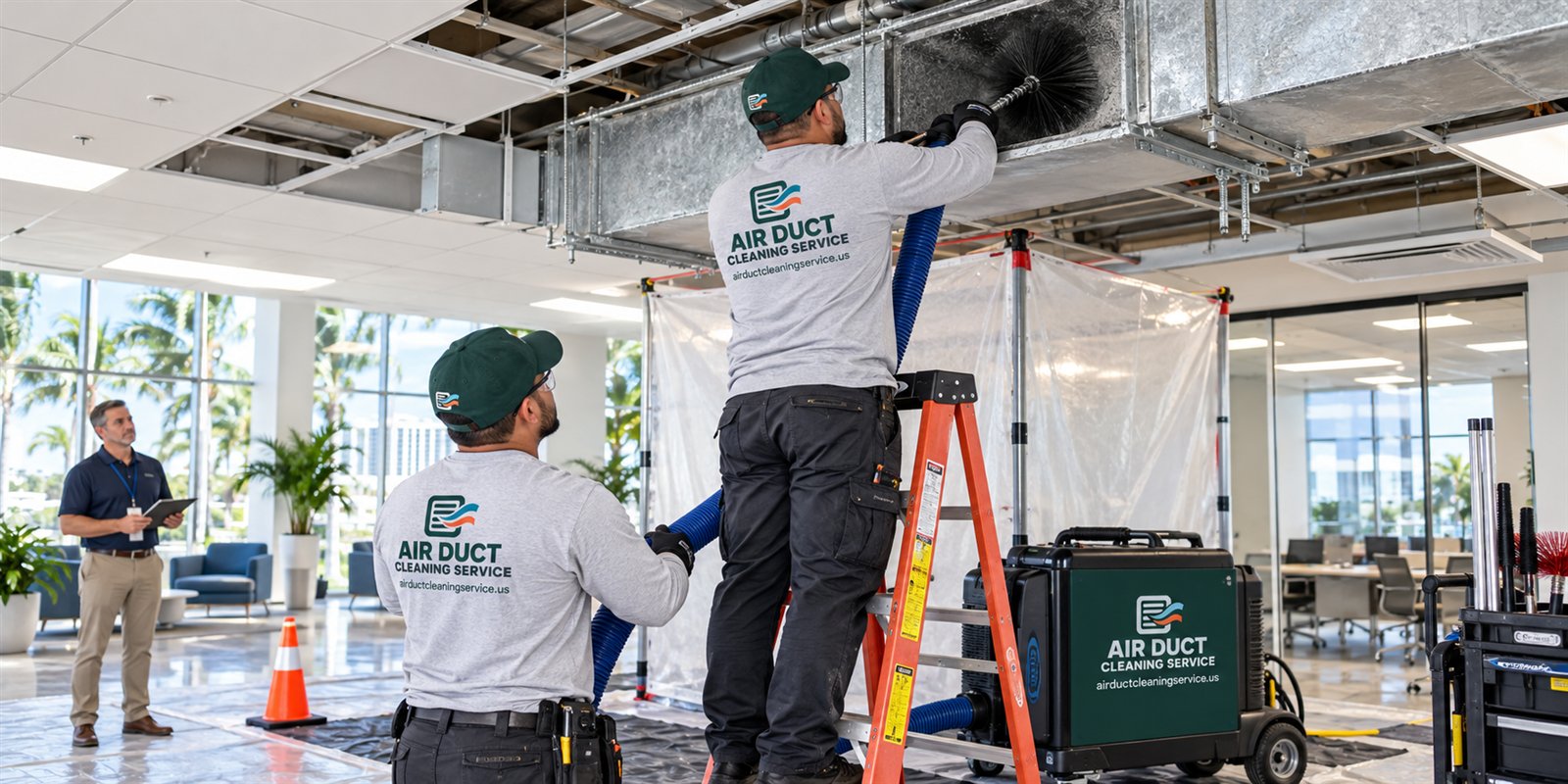
How commercial duct work differs from residential
A house typically has one or two air handlers and ducts that are reached from a closet, a garage or an attic. A commercial space may have a packaged rooftop unit, several split systems, a central air handler in a mechanical room, long trunk lines above a drop ceiling, and a mix of supply, return and exhaust runs. Ducts can be large rectangular sheet metal, round spiral duct, lined duct or duct board, and they may serve areas with very different uses, such as an office, a kitchen, a storage room and a restroom.
Because of that variety, a commercial scope is built system by system. Someone has to identify which air handlers serve which areas, which runs are accessible, where access panels exist and which parts of the building cannot be disturbed during business hours. This is why quotes are given only by phone after a discussion of the space, and why larger or more complex properties need an on-site visit first. A service call charge applies to that visit and is explained on the phone before dispatch. The page on commercial duct cleaning describes the service in general terms.
When does a business actually need duct work?
As with homes, the answer comes from evidence, not a calendar. Triggers that justify a look include a renovation or buildout that produced dust, a change of tenant, odors that persist after other causes are ruled out, visible dust streaking around supply diffusers, water intrusion from a roof or leaking coil, pest evidence in a ceiling space, complaints from staff or customers about stuffy or dusty conditions, and a request from a landlord, lender or buyer for documentation of system condition.

A business should also be cautious about attributing every complaint to the ducts. Poor ventilation, a clogged filter, a rooftop unit with a failed economizer, cleaning chemicals, new furniture and fluctuating humidity all produce comfort complaints. An inspection that separates those causes from duct condition saves money and prevents the wrong fix. The guide on medical and office duct work and the one for restaurants and retail give examples by business type.
Scheduling and downtime
Most commercial duct work is planned around the way the space is used. Offices and retail often prefer evenings, early mornings or weekends. Medical, daycare and school settings have their own rules about occupancy and about which areas must stay undisturbed. Restaurants coordinate around service hours and health inspection concerns. Shared buildings may need to reserve elevators or loading areas in advance and notify neighbors.
We do not promise arrival windows or fixed durations on a website, because the true answer depends on the building. During the phone call you will be asked about operating hours, quiet periods, access to mechanical rooms and ceilings, security or badge procedures and who will be on site to open doors. Honest planning means telling you before the work starts what has to be moved, which rooms will be affected and for how long. If a part of the scope has to be pushed to a second visit, that should be agreed in advance, not discovered at the end of the night.
Access, ceilings and the things that surprise people
Commercial ducts are often hidden. Above a drop ceiling there may be a maze of ducts, conduit, sprinkler lines, cable trays and insulation. Some of these ceilings are lay-in tiles that lift out; others are drywall that needs an access cut. Mechanical rooms may be locked, crowded or shared with other tenants. Rooftop units need roof access, and roof access in turn requires management permission and safe working conditions.
A good scope names these access points ahead of time. It states who provides keys and ladders, who protects equipment and furnishings, and how any new openings will be closed afterward. The page on duct access points and service panels explains how openings are made and sealed. If an area is not reachable without removing something that belongs to someone else, such as a tenant's cabling or a landlord's insulation, that should be written down before work begins.
Documentation and records for a business
Businesses often need more than a verbal assurance. A landlord may ask a tenant for proof that maintenance was done; a lender or buyer may ask for condition documentation; a medical or school setting may have internal policies; a restaurant may keep records for its own inspections. The right paperwork includes the date, the areas covered, the systems serviced, the methods used, before and after photographs taken from identifiable locations, and a plain description of anything found that is outside a cleaner's scope.
The written report should say what was observed and avoid claims that cannot be proven. See what the written report should say for a model of useful content, and photo documentation for how photos should be organized. Keep these records with your maintenance file, and note filter changes alongside them.
Restaurants, kitchens and grease
Kitchen exhaust hoods and grease ducts are a distinct field with their own standards, schedules and fire safety requirements, usually handled by companies that clean hoods and exhaust systems. A general duct cleaning service is not a substitute for that work. What a duct cleaner can do in a restaurant is look at the dining area and kitchen supply and return air systems, check for grease or smoke film on diffusers near the cooking line, and recommend the appropriate trade when the issue is exhaust grease.
Be careful with any provider who claims to handle every duct in a restaurant without discussing the difference between comfort air ducts and exhaust systems. The right question is: which ducts will you clean, which will you not, and who is responsible for the rest? Our problem page on cooking smoke and grease in vents goes into the residential version of this concern.
Tenants, landlords and who is responsible
In leased space the responsibility for ducts and air handlers is set by the lease. In many multi-tenant buildings, the landlord owns and maintains the central equipment while the tenant is responsible for what is inside the suite, but the details differ. Before commissioning a cleaning, a tenant should read the lease or ask management who owns the air handler, who may open ceilings and who must be notified. Doing work without permission can create disputes, and doing it in the wrong zone may leave the actual source of the complaint untouched.
Landlords who want to document condition between tenants can benefit from the inspection first, then clean only what the evidence supports. The page on landlord duct responsibilities and the one on building a property manager duct program explain the reasoning behind a records-based approach.
Choosing a commercial provider
Ask the same questions you would ask for any contractor serving a business. Can they show proof of insurance, and will they provide a certificate to your building if required? What methods will they use for your duct material? How will they contain dust, and what will they do if they discover something unexpected? What will be documented? Who will be on site, and who is the contact if something goes wrong at night?
Verify credentials directly instead of relying on logos, and read the guide on verifying credentials and insurance. Be wary of providers who offer a flat promise before seeing the building, or who pressure you with fear of fines or lawsuits. A professional will describe the evidence and leave the decision with you.
Examples from different kinds of spaces
A small professional office in a strip plaza has a single packaged unit on the roof and a ceiling plenum above lay-in tiles. After a buildout, staff notice dust at the supply diffusers. The plan begins with a ceiling-level inspection and a look inside the unit, then a scope that covers the supply and return runs the evidence supports, scheduled after hours with tiles protected and replaced.
A retail tenant in a mall space has several diffusers with dark streaking and customers mention a stale smell. The first questions are about the filter, the unit's operation and any past leaks from the roof or neighboring spaces. The inspection may show that a dirty filter and an over-cooled space with condensation at the diffusers explain most of it. In that case cleaning the diffusers and adjusting the maintenance routine is the honest answer, rather than a full system job.
A property manager taking over a multi-tenant building wants a baseline of the common-area air handlers. Here the value is in the records: a walk-through, photographs of each handler and its filter rack, notes on accessible ducts, and a priority list. Cleaning is then planned only for the units where the evidence calls for it. A baseline of this kind also supports later conversations with tenants and owners.
Safety, insurance and coordination on a work site
Commercial work involves more coordination than a home visit. Crews may need to work at height, move equipment through shared corridors, use building elevators and enter locked mechanical rooms. A responsible provider carries appropriate insurance, follows the building's rules for contractors, wears suitable protective equipment and arranges to keep the public away from work areas. Management may require a certificate of insurance, a list of workers and a work schedule in advance.
Fire and life safety systems deserve respect. Ceiling spaces contain sprinkler lines, smoke detectors and sometimes fire dampers inside ducts. Technicians should not disturb these devices, and anything that looks damaged or blocked should be reported to the building owner instead of being adjusted. If the work requires temporarily isolating a detector or shutting down an air handler, that must be coordinated with whoever is responsible for the building's safety systems. Ask the provider how they handle this and who they will notify.
Filters, maintenance routines and what a business can do between visits
Much of what keeps a commercial duct system clean happens between cleanings. Filters in rooftop units and air handlers are the main defense, and they only work when they are the right size, seated properly and changed on a routine that matches the space. A retail floor with heavy foot traffic, a salon, a gym or a space next to a loading dock will load filters faster than a quiet office. Someone should be named as responsible for checking them, and the date of each change should be written down.
Other habits help as well: keep supply diffusers and return grilles unblocked by shelving, boxes or signage; report any water stains on ceiling tiles right away; make sure condensate drains from rooftop and ceiling units are clear; and ask the HVAC maintenance contractor to note any visible buildup inside the unit at each service visit. If the contractor sees something that suggests the ducts need attention, an inspection then settles the question with photographs. These small routines reduce the odds of needing a large cleaning job, and they give you an organized record if anyone ever asks about maintenance.
What to have ready and next steps
When you call, have a few facts ready: the size and type of the space, the number and kind of air handlers if known, whether there are rooftop units, the type of ceiling, the hours the business operates and when a visit would cause the least disruption, and who is the landlord or property manager. Photos of the units, diffusers and any problem areas help. Mention any recent construction, water events or pest activity.
From there you will be told whether a phone quote is possible or an on-site visit is needed. Nothing is decided on the call unless you decide it. Call when you are ready to describe the space, and compare the plan with the questions in this page before agreeing to anything.
Questions people ask
Can commercial duct cleaning be done after hours?
Often, yes. Many offices and shops prefer evenings or weekends. What is possible depends on the building, access to mechanical areas, security procedures and landlord rules. Discuss operating hours and quiet periods on the call so the plan can fit around your business, and agree in advance on what must be moved or protected.
Do I need an on-site visit before getting a quote?
For simple spaces a phone conversation may be enough. Larger or more complicated properties, such as multiple air handlers, hidden ceiling ducts or suspected water damage, need an on-site visit to set the scope. A service call charge applies and is explained on the phone before anyone is dispatched.
Will I get documentation for my landlord or lender?
You should ask for a written summary with the date, areas and systems serviced, methods used and before and after photographs from identifiable locations. Ask for the findings that are outside a cleaner's scope to be stated plainly. Share the request on the call so the report is prepared the way you need it.
Does this cover kitchen exhaust hoods and grease ducts?
Kitchen exhaust is a separate field with its own standards and is usually handled by hood and exhaust cleaning companies. Comfort air supply and return ducts in a restaurant can be inspected and cleaned, and the technician should tell you clearly which systems are in scope and which belong to another trade.
Who is responsible for ducts in a leased suite?
It depends on the lease. Landlords often maintain central equipment while tenants handle items inside the suite, but the lease controls. Check it or ask property management before ordering work, particularly if ceilings must be opened or rooftop equipment is involved, so permissions and responsibilities are clear.
Will cleaning solve staff complaints about stuffy air?
Not necessarily. Complaints can come from ventilation settings, filters, humidity, rooftop unit faults or the room itself. An inspection separates duct condition from other causes so you fix the right thing. Cleaning helps when the evidence shows buildup in the ducts, and it should not be offered as a cure for comfort or health complaints.
Describe the situation by phone and we will tell you what the job involves. Quotes are given by phone. Jobs that cannot be quoted without seeing them need a technician on site, and the service call charge is explained on the phone before anyone is dispatched.
Related pages
- Commercial Ducts: How cleaning scope, access and after-hours scheduling work for duct cleaning in occupied offices, shops and restaurants across South Florida.
- Restaurants and Retail: A guide for small restaurants and retail shops on duct care: grease and foot-traffic dust, how duct work differs from hood cleaning, and planning visits.
- Offices and Clinics: How small offices and clinics can plan duct inspection and cleaning: scheduling around occupancy, records, shared systems and when stricter requirements apply.
- Access Points: How technicians get into ducts: existing openings, cut-in access panels, the materials used to close them and what to expect to see afterward in your home.
- Property Managers: A practical guide for property managers: how to plan duct inspections across many units, keep records, schedule visits and give tenants clear notice.
- Short-Term Rentals: How hosts of vacation and short-term rentals can manage odors, dust and cooling complaints with a filter routine, turnover checks and evidence-based cleaning.
A short walk through the questions managers ask most
Business owners and property managers tend to ask the same handful of questions. The first is whether the work will interrupt operations. It depends on the space, but the plan usually involves choosing a quiet window, protecting furniture and equipment and working in sections so that part of the space remains usable. The second is how to know what actually needs attention, which an inspection answers before anything else. Each space has its own priorities. A restaurant worries about kitchen exhaust, an office about tenant comfort and a retail shop about customer experience. We ask about yours before suggesting anything.
The third question is about records. Managers want something they can file, showing what was inspected, what was found and what was done. We describe findings in plain written language with photographs where access allows. We do not claim credentials, and the report says only what the technician saw and did. If you manage several locations, tell us whether they share a design, since that lets us compare findings and plan consistently across sites. Where a report is needed for a landlord, insurer or board, we can shape the description to fit.
The fourth is about responsibility, especially in leased space. Who pays, who approves and who manages the equipment are questions between you, your landlord and your lease. We can describe the scope in writing so that the right person can make the decision, and we explain any problem that sits outside our work. The answers to these questions are given in plain terms. If you need something in writing for a board or an owner, ask for it. When approvals are required, we wait for them, and we make sure the people responsible know what is planned. That protects everyone and avoids disputes about who asked for what and when the work took place.