
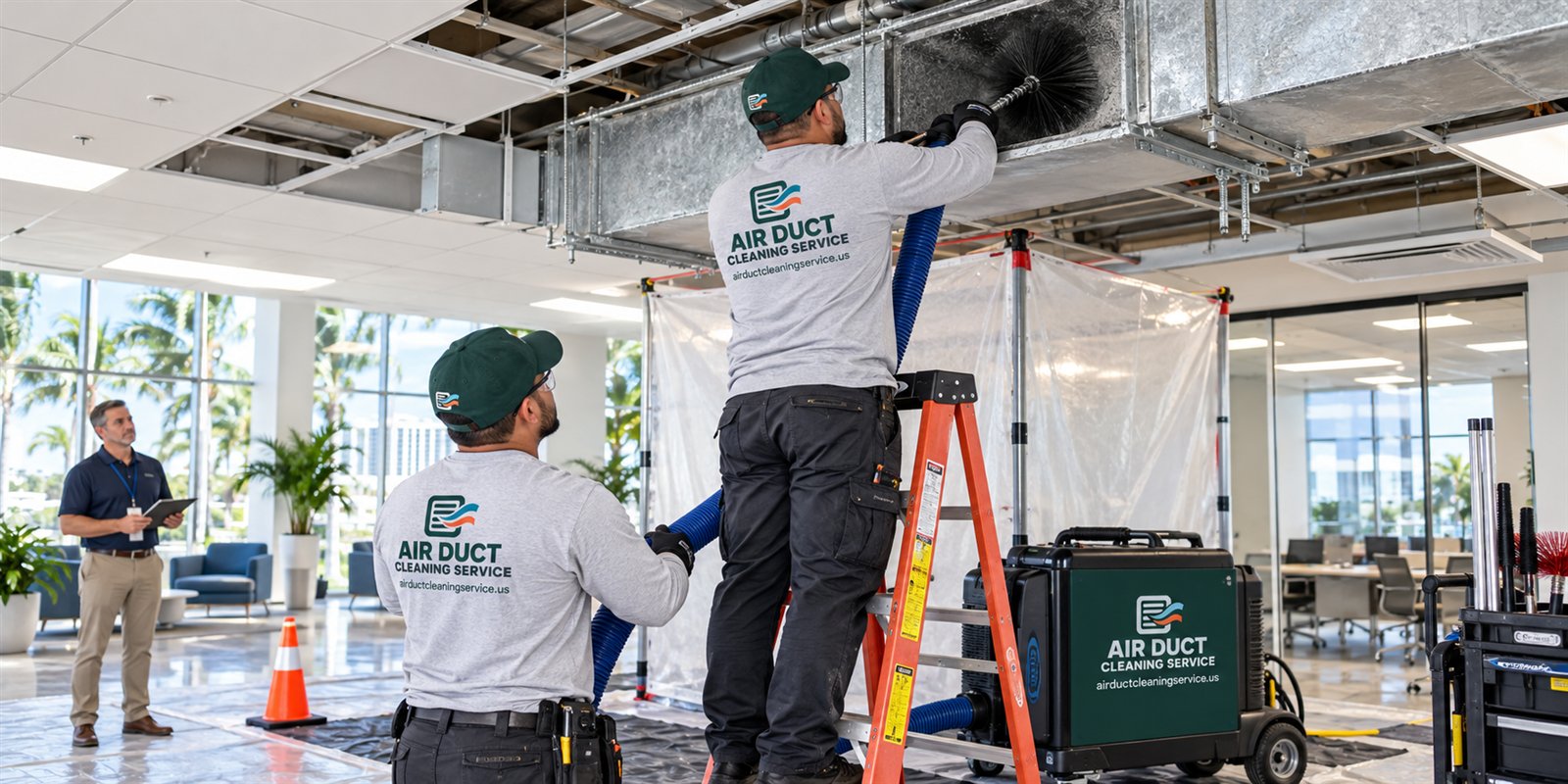
Business air systems are not just bigger home systems
Small commercial spaces often use packaged rooftop units, split systems with ceiling air handlers or a mix of several smaller systems. The ductwork may be sheet metal run above a drop ceiling, round spiral duct in an open ceiling, or lined duct with insulation inside. Return air often travels through the ceiling space itself, which can be a dusty and cluttered environment.
Occupancy is also different. A shop with a steady stream of customers brings in outdoor dust, lint from clothing and cardboard fibers from stock. A restaurant adds cooking vapors, moisture and grease. A salon or a nail shop adds chemical odors and fine particles. Doors open constantly, so humid outdoor air is drawn in as fast as the system can dry it.
These differences matter for how ducts are inspected and cleaned. Access panels may be above a ceiling or on a roof, runs are longer and the building may have shared systems with neighboring units in a plaza. A business owner needs a plan that fits the lease, the hours and the way the space is used.

Know which system you are talking about
In a restaurant, there are two separate air systems that are often confused. The first is the comfort system, the air conditioning that heats and cools the dining room and back of house and moves air through supply and return ducts. The second is the kitchen exhaust system: the hood over the cooking line, the grease filters, the exhaust duct that carries vapors up and out, and the fan on the roof.
Duct cleaning, as discussed on this site, applies to the comfort system. The kitchen exhaust system is a different kind of work, governed by fire safety rules and typically handled by contractors whose work is kitchen exhaust cleaning. Grease buildup in an exhaust duct is a fire hazard and is not a job for a general duct cleaner or for a store owner with a brush. If you are not sure which system you are dealing with, ask when you call.
Keeping the distinction clear protects you. A company that offers to clean your hood and your air conditioning ducts in one visit should be asked exactly what it will do on each system, what credentials it holds for each and what documentation it provides. The page on commercial duct cleaning covers the comfort-system side.
Grease and cooking vapors in the comfort system
Even though the kitchen exhaust is a separate system, grease and cooking vapors do find their way into the comfort system. Makeup air that is drawn into the kitchen, return grilles near the cooking line and doors that connect the kitchen to the dining room all allow vapors to travel. Over time, a return grille near the kitchen can collect a film of grease and dust that is sticky to the touch, and a supply diffuser in the dining room can show brown streaks.
A grease film can capture dust and become harder to remove. It can also affect the coil and blower if the return air passes through them. A technician can look at the return grilles, the filters, the coil and the blower and photograph what is there. If the evidence shows grease in the comfort system, cleaning those components and fixing the cause, such as pressure imbalance or a leaking return near the kitchen, is reasonable.
The page on cooking smoke and grease in vents explains how the evidence is read. If the evidence points to the kitchen exhaust itself, that needs a kitchen exhaust contractor.
Pressure balance, makeup air and why smells travel
A restaurant that smells of the kitchen in the dining room, or a shop that smells of the neighboring unit, often has a pressure problem. A strong exhaust hood pulls air out of the kitchen. If makeup air is insufficient, the kitchen becomes negative, and air flows in from wherever it can, including the dining room, the back door and the ceiling space. Smells then flow with it.
Adjusting pressure is not a cleaning job. It involves balancing supply, return and makeup air, and sometimes adding or adjusting makeup air equipment. A technician can check the airflow and pressure relationships in the space, and a mechanical contractor can make changes. Ask for an assessment before spending money on cleaning for an odor complaint.
In a retail plaza with shared walls and a shared ceiling space, smells and dust can also travel from a neighboring unit through the plenum above the ceiling. The page on condo neighbor odor through ducts describes a similar pattern in multi-unit buildings and how it is investigated.
Foot-traffic dust, cardboard and retail stock
A retail shop collects dust from several unusual sources. Customers carry in grit and lint, new stock comes in cardboard cartons that shed fibers, clothing and fabric products release lint and open doors admit outdoor dust and pollen. All of this meets the return air and heads for the filter.
Because commercial filters are often neglected, the result is a loaded filter, reduced airflow and dust bypassing into the system. Make filter checks part of the opening or closing routine, put them on a calendar and assign someone to do them. Record the date on the filter and keep a log.
Dust near registers and diffusers is one place a customer sees the problem. Wipe them as part of routine cleaning. If dust is heavy or returns quickly, ask for an inspection of the return paths and ceiling space. The page on dust that returns quickly after cleaning explains why an address-the-cause approach matters.
Cleaning the grilles and diffusers customers can see
Customers cannot see the inside of a duct, but they can see the diffuser above their table or the grille in the fitting room ceiling. A dusty or stained diffuser tells them something about how the place is run, whether or not the system is actually dirty. Wiping diffusers and return grilles is a simple, regular chore that belongs on the cleaning checklist.
Use a damp cloth or a vacuum with a brush, work from a stable ladder and follow the building's safety rules. Do not spray cleaners into the opening, and do not remove ceiling tiles or panels unless you know what is above them. If a diffuser is stained with dark streaks that return quickly, photograph it and ask for an inspection, since the cause may be condensation or a leak and not just dust.
Humidity, condensation and sweating diffusers
Frequent door openings and kitchen moisture make humidity control a challenge in South Florida businesses. If the system cannot keep up, you may see condensation forming on supply diffusers, drips from ceiling tiles, damp spots on drop ceilings or a musty smell in the dining area. These symptoms often come from a mismatch of airflow, temperature setpoints and humidity, not from dirt.
Check that the thermostat is set to auto fan and not on continuous fan when the space is occupied by humid air, since continuous fan can re-evaporate moisture from the coil. Keep doors closed when possible and make sure the entry has a way to limit the inflow of outdoor air. A technician can check the coil, airflow and condensate drainage.
The pages on condensation and sweating ducts and indoor humidity control in South Florida explain how these are investigated. Stained ceiling tiles should be photographed and replaced after the moisture source is fixed.
Inspections that fit a business: access, ceilings and rooftops
A technician inspecting a business system will often need to open ceiling tiles, access panels or a rooftop unit. Plan ahead: clear stock and shelving from under access points, tell staff and arrange for someone to let the technician in. In a plaza, the landlord may control roof access and may need to give permission or an escort.
The inspection looks at filters, coil, blower, drain pan and line, accessible ducts and diffusers, and records the findings with photographs. In a restaurant, the technician will also note the relationship between the kitchen exhaust, makeup air and the comfort system, but will not clean the exhaust duct. The page on how duct inspection works explains the general process.
Ask for the findings in writing with photos, so you can pass them to the landlord, a property manager or a health or fire inspector if needed. Rooftop work involves fall hazards and weather, so only trained people should do it.
Scheduling around customers and opening hours
Duct work is noisy and can create dust, so it is usually done outside business hours. Early mornings, evenings, closed days and slow periods are common choices. Tell the office what your hours are, whether the building has restrictions on after-hours entry, whether alarm arrangements or keys are needed and who will be present.
Plan for the space to be ready. Cover or move food, equipment and merchandise near work areas. Protect displays and store fixtures from dust. Make sure staff know the plan, especially if work is done at night and someone must open the door.
Arrival timing is coordinated by phone, and no window can be promised in advance. If you have a hard deadline, such as an inspection or an event, say so when you call so the office can plan. The page on the commercial duct FAQ answers more questions about business jobs.
Health inspections, fire inspections and landlord requirements
Restaurants and some retail businesses are subject to inspections by health, fire and building authorities. Requirements vary by municipality, and the rules that apply to your business depend on your use, your building and your lease. This guide cannot list them, so check with your local authority and your landlord about what applies to you.
In general, keep records. A log of filter changes, a written inspection report with photos, invoices for cleaning and notes on repairs show that you maintain your system. Keep the kitchen exhaust records separate from the comfort system records, and keep them where an inspector can find them.
If your lease assigns responsibility for the air system to you or to the landlord, know which. In a plaza, the landlord often owns rooftop units and the tenant pays for maintenance, or the other way around. Read the lease and ask the property manager before you commission work.
A practical plan for a small business owner
A realistic plan for a small business is short. Assign someone to check the filters on a set day each month and to note the date. Wipe diffusers and return grilles during routine cleaning. Keep the area around the air handler or rooftop access clear. Photograph any stains, drips or smells and report them early. Once a year, or when something changes, ask a qualified technician to inspect the system.
Clean when the evidence supports it: visible buildup on the coil or blower, grease in the comfort system, moisture damage, pest contamination or construction dust after a remodel. Avoid fixed-schedule cleaning without evidence, and avoid any offer that bundles the comfort system and the kitchen exhaust without clear separation of the work. The pages on how to choose a duct cleaner and red flags in duct cleaning offers are useful before you sign anything.
Quotes are given by phone, and complicated jobs need an on-site visit. A service call charge applies and is explained on the phone before anyone is dispatched. If you run a restaurant or shop in Broward, Palm Beach or Miami-Dade and want help working out what your system needs, call and describe your space and what you have noticed.
Questions people ask
Is duct cleaning the same as hood cleaning?
No. Duct cleaning applies to the comfort system that heats and cools the space. A kitchen hood and exhaust duct is a separate system with its own fire safety requirements and is handled by kitchen exhaust contractors. Ask any company exactly which system it is cleaning and what documentation it provides for each.
Why does my dining room smell like the kitchen?
Often it is a pressure issue: the exhaust hood removes more air than the makeup air supplies, so air and odors are drawn from the dining room into the kitchen or move through the ceiling space. A technician or mechanical contractor can check airflow and balance. Cleaning alone rarely solves it.
How often should a shop change its air filters?
Set a routine, such as a monthly check, and replace filters when they look loaded. Shops with heavy foot traffic, cardboard stock or fabric products can load filters faster. Write the date on each filter, keep a log and make the check part of someone's regular opening or closing duties.
Do I need to clean ducts before a health or fire inspection?
Requirements vary by location and use, so ask your local authority and landlord what applies. Kitchen exhaust cleaning is typically regulated separately. For the comfort system, an inspection report with photos and filter records is usually more useful than cleaning with no evidence of need.
Can duct work be done after hours?
Yes, evenings, early mornings and closed days are common. Tell the office your hours, access and alarm arrangements, and who will be present. Clear the work areas and protect fixtures and stock. Arrival timing is arranged by phone and no window can be promised in advance.
Who is responsible for the air system, me or my landlord?
It depends on the lease. In many plazas the landlord owns rooftop units and the tenant pays for maintenance, but arrangements vary. Read your lease and ask the property manager before you commission work, and get permission for roof access if it is needed.
Describe the situation by phone and we will tell you what the job involves. Quotes are given by phone. Jobs that cannot be quoted without seeing them need a technician on site, and the service call charge is explained on the phone before anyone is dispatched.
Related pages
- Commercial Ducts: How cleaning scope, access and after-hours scheduling work for duct cleaning in occupied offices, shops and restaurants across South Florida.
- Commercial FAQ: Answers for business owners and managers on duct work in commercial spaces: scheduling around operations, downtime, access, documentation and scope.
- Cooking Residue: Cooking residue can reach home returns and registers, especially in open floor plans. Learn how to spot it, how it differs from dust, and what cleaning can do.
- Sweating Ducts: Water beads on registers and duct surfaces are a clear warning sign in humid South Florida. Learn the causes, what to document and what a technician checks.
- Offices and Clinics: How small offices and clinics can plan duct inspection and cleaning: scheduling around occupancy, records, shared systems and when stricter requirements apply.
- Drywall and Paint: How to protect a South Florida air system during drywall, sanding and painting: capping registers, stopping the fan and timing any cleaning afterward.
Questions to Settle With the Landlord Before a Visit
Business space is often leased, and the air system may belong to the building, the tenant or a mix of both. Before you call us, ask the landlord or property manager who is responsible for ductwork above the ceiling, rooftop units, grilles inside the suite and the filters. A lease usually has a section on maintenance duties, and some have separate rules for contractors. Knowing the answer avoids a situation where the work is done and then questioned afterward. Nothing is changed in your system without being explained to you first.
Ask next about access and timing. Does the building require advance notice for contractors, a certificate of coverage from the company, or use of a freight elevator? Are there quiet hours or restricted days? Can the roof be reached by your contractor, and who holds the key? These requirements vary widely from one plaza or tower to another, and getting them in writing saves a lot of back and forth. We can tell you what we need to see on site, though we do not manage your building paperwork.
Lastly, decide who in your business can approve work and who should be present. A manager who knows which rooms are sensitive, such as a food prep area, a stockroom or a display window, can guide the crew far better than a phone call afterward. Share the opening schedule and any days when deliveries arrive. The scope and any quote are explained before work begins, and changes are discussed with you as findings come up. Take notes if that helps, and keep them with your other household maintenance papers.