
What offices and small clinics have in common
Whether it is an accounting office, a dental suite, a chiropractor or a small medical practice, these spaces share traits that shape how their air systems should be managed. They are occupied during set hours and empty at night. They have a reception area, several smaller rooms and often a back room for storage, supplies or equipment. The air system is usually a packaged unit on the roof or a split system with a ceiling air handler, with ductwork above a drop ceiling.
Many are in multi-tenant buildings, where the landlord owns the building systems and the tenant controls the interior. In some cases several suites share a unit or a ceiling return plenum. That affects who can authorize work, who pays and how a problem in one suite can reach another.
Expectations also differ. A clinic's patients and staff care about cleanliness. A smell or visible dust at a vent is noticed quickly and can affect how a practice is perceived. That is a good reason to keep a routine and a record, and a reason to rely on evidence and not on fear when deciding what work to do.

Start with the filter and the maintenance contract
The most effective step for a small office is to know who is responsible for filters and routine maintenance. In many buildings, the landlord has a contract with an HVAC company that changes filters and checks rooftop equipment on a schedule. In others, the tenant handles it. If nobody is sure, filters may go unchanged for a long time, which shows up as weak airflow, uneven temperatures and dusty registers.
Find out what the lease says, ask the property manager for the filter size and schedule and ask for a copy of the last service report. If you are responsible, assign someone to check the filter monthly, write the date on it and keep a log. The page on filters and MERV ratings explains how to choose, and a technician can say what your equipment supports.
If you are in a medical setting, filter requirements may be set by regulations or standards that apply to your type of facility. Those requirements are beyond the scope of this guide, and you should confirm them with your licensing body, your equipment manufacturer and a qualified mechanical contractor.
Scheduling around occupancy
A visit should not disrupt patients or staff. Most office and clinic work is scheduled outside business hours, on a weekend or on a closed afternoon. Cleaning equipment is loud and can raise dust near registers, so work during occupancy is rarely a good idea in treatment rooms, waiting areas or quiet offices.
When you call, explain your hours, any access restrictions, alarm arrangements and who will be on site. Tell the office whether the space has areas that need extra care, such as rooms with equipment, supplies or records. Ask what the technician will need to reach so that you can move furniture and clear the path ahead of time.
Tell the building's property manager too. Many buildings require notice for after-hours work, a certificate of insurance from contractors, or an escort for roof access. Arrival timing is coordinated by phone and no window can be promised in advance, so allow flexibility around your plans. The page on what happens on the phone call explains how scheduling works.
What an inspection covers in a small commercial space
A technician's inspection of an office or clinic system looks at the same things as in a home, adapted for the setup. It covers the filter and filter rack, the air handler or rooftop unit, the coil, blower and drain pan and line, accessible ducts and diffusers, the ceiling space where return air travels and any signs of moisture or pests. The findings are recorded with photographs.
The aim is evidence. If the filter is clean and the coil and blower look normal, the inspection will say so. If there is heavy debris on the coil, a clogged drain, staining around diffusers or buildup in accessible ducts, the photos will show it. The page on how duct inspection works describes the process, and what the written report should say lists what you should receive.
A written report with photos is useful beyond the immediate decision. It can be shared with the landlord, kept for your own records and given to an auditor or inspector if asked.
Common complaints and what they usually mean
Offices raise a familiar set of complaints. A musty smell in a back room often traces to a wet drain pan, damp ceiling tile or a closed storage room with no airflow. A room that is always cold or always warm often has a balance problem, such as a damper position or a blocked return. Dust at a diffuser may be a dirty filter, a leaking return plenum or construction dust from a neighboring suite. Noise is often a loose panel or a restricted diffuser.
Staff may also report headaches or stuffy air, which have many possible causes, including ventilation rates, temperature, humidity and individual health. A duct inspection can check the system's physical condition, but it cannot diagnose health symptoms. If concerns persist, an indoor air quality professional or an occupational health resource may be the right next step.
The pages on musty smell from vents and uneven cooling room to room explain common causes. Keep a short log of complaints with dates and locations, because patterns help a technician find the cause.
Moisture, ceiling tiles and the plenum above the ceiling
In many small commercial buildings, the space above the drop ceiling serves as a return air plenum. That means the air returning to the air handler passes through the same space as wiring, pipes and the backs of ceiling tiles. A leak from a roof or a pipe can wet insulation and tiles, and a stained tile is often the first sign.
If you see a stain, photograph it and note the date. Look for the source before replacing the tile, since a replacement tile will stain again if the leak continues. A technician can check the ducts and insulation above, and a contractor can fix the leak. The page on moisture readings and humidity explains how moisture is measured.
Condensation on diffusers is another common issue, particularly in humid weather with doors opening frequently. It can cause drips onto ceiling tiles and desks. The page on condensation and sweating ducts explains how it is investigated.
Waiting rooms, restrooms and shared spaces
Waiting rooms and restrooms attract the most comments about air. A busy waiting room has people coming in from outdoors, doors opening and closing and a lot of heat from bodies and electronics. If the supply is undersized or the return is restricted, the room feels warm and stuffy even when the thermostat says otherwise. Restroom exhaust fans that are weak or blocked let odors drift into hallways and reception.
Check that restroom fans run and move air, that the grille is clean and that the duct is connected and vents outdoors. Check that supply diffusers in the waiting room are open and that nothing blocks the return grille. A technician can measure airflow at the diffusers and compare it to what the room needs.
In shared buildings, ask the property manager whether common areas have their own system or share one with your suite. The answer decides who can fix what, and whether the first call goes to the landlord's HVAC contractor or to you.
When stricter requirements apply
Some medical and clinical spaces have stricter air handling requirements than ordinary offices. Operating rooms, certain procedure rooms, sterile processing areas, isolation rooms and some labs may be subject to ventilation, filtration and pressure standards that are set by regulation, licensing bodies or accreditation programs. Whether and how those apply to a particular practice depends on the services provided.
This guide is not a source for those requirements, and an ordinary duct cleaning visit is not a substitute for compliance work. If your space falls under such rules, work with your facility manager, your licensing or accreditation contact and a qualified mechanical contractor who understands them. Be honest with any contractor about the nature of your space so that they can tell you whether the work you are asking about is appropriate.
For general offices and low-acuity clinics, a duct inspection and evidence-based cleaning where needed is a reasonable maintenance step, but no company should promise that cleaning will meet a standard it has not seen. Ask what the contractor will and will not do, and get it in writing.
Dust and debris control during cleaning
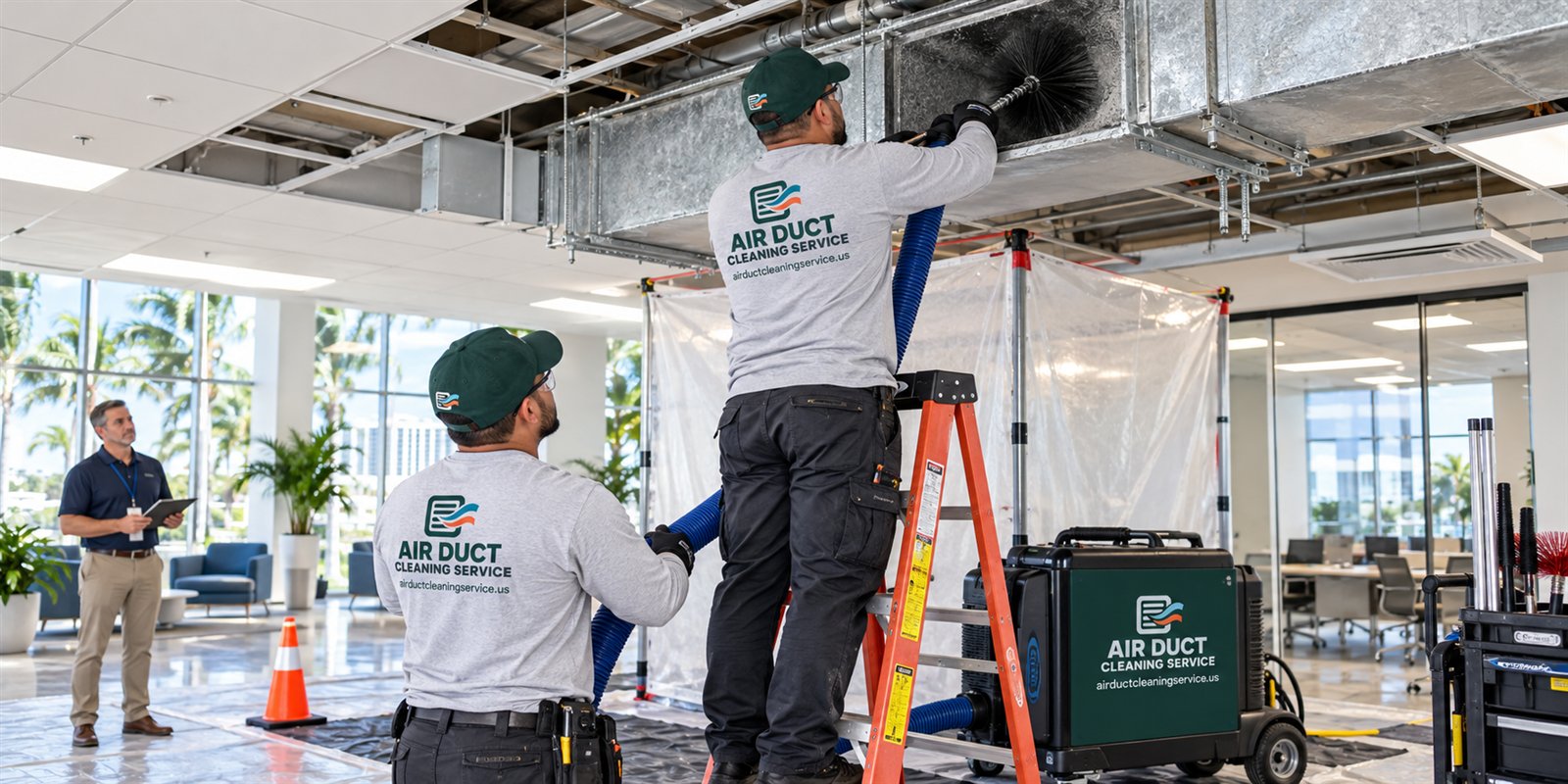
Cleaning ducts in an occupied commercial space calls for planning. Equipment that creates negative pressure and captures debris with a HEPA-filtered collector reduces the dust released in the room. Registers and diffusers should be covered or removed carefully. Furniture, supplies and records near the work area should be moved or covered.
In a clinic, plan around areas that must stay clean. Do not schedule work in a treatment room while supplies are stored open, and ask the contractor how they will protect sterile or sensitive areas. After the work, wipe horizontal surfaces and replace the filter.
The page on the negative air machine explained describes how debris is contained, and rotary brush versus air whip methods covers the cleaning methods. Ask which methods will be used on your duct material, since lined and fiberglass ducts need gentler handling than bare sheet metal.
Records, reports and what to keep
Keep a simple maintenance file for the space: filter size and schedule, the last service report, inspection reports with photos, cleaning invoices, notes on leaks or complaints, the landlord's contact and the HVAC contractor's contact. Keep it where the next office manager will find it.
A record helps in several ways. It lets you show that the system is maintained if a tenant, landlord, inspector or insurer asks. It helps a technician understand history. It helps you decide whether a problem is new or recurring. And it reduces the chance that a good routine disappears when a staff member leaves.
The page on keeping your own duct records gives a format you can adapt. If you manage more than one site, the page on a duct program for property managers describes how to organize records across many units.
Planning a first call and a first visit
When you call, describe the space and what you have noticed. Mention whether it is an office or a clinic, how large it is, where the equipment is, whether there is a rooftop unit and who owns the building. Describe symptoms with dates and locations. Tell the office whether there are any sensitive areas that need careful handling, and whether the work must be after hours.
Quotes are given by phone, and complicated jobs need an on-site visit. A service call charge applies and is explained on the phone before anyone is dispatched. After the visit, expect a written summary with photos and a plain recommendation. You can take time to decide, and a second opinion is always reasonable.
The page on commercial duct cleaning describes the service, and the commercial duct FAQ answers more questions. If you manage an office or a small clinic in Broward, Palm Beach or Miami-Dade, call and describe what you have noticed, and we will help you work out the next step.
Questions people ask
How often should a small office have its ducts cleaned?
There is no fixed interval that suits every office. Needs depend on evidence such as filter condition, debris on the coil and blower, moisture events and nearby construction. Routine filter changes and an occasional inspection with photos are a better guide than an automatic schedule.
Does duct cleaning meet medical facility air standards?
Not on its own. Some clinical spaces are subject to ventilation, filtration and pressure requirements set by regulation or accreditation, and those are handled with your facility manager, licensing contact and a qualified mechanical contractor. Tell any contractor about your space so they can say whether the work is appropriate.
Can the work be done while the office is open?
It is usually better to schedule outside business hours because the equipment is loud and can raise dust near registers. Evenings, weekends and closed afternoons are common. Tell the office your hours and access arrangements, and check your building's rules on after-hours work and roof access.
Who is responsible for the HVAC system in a leased suite?
It depends on the lease. Landlords often own rooftop units and have a maintenance contract, while tenants may be responsible for filters or interior components. Read the lease, ask the property manager for the service schedule and the last report, and get permission before commissioning work.
My staff complain of stuffy air or headaches. Will cleaning help?
Maybe not. Those symptoms have many causes, including ventilation, temperature, humidity and individual health. An inspection can check the physical condition of the system and look for debris or moisture, but it cannot diagnose health issues. If concerns continue, consider an indoor air quality professional or occupational health resource.
What should I receive after an inspection?
A written summary with dated photos showing the filter, air handler, coil, blower, drain and accessible ducts, what was found, and what is recommended and why. If cleaning is done, expect before and after photos. Keep the report with your maintenance records and share it with your landlord if needed.
Describe the situation by phone and we will tell you what the job involves. Quotes are given by phone. Jobs that cannot be quoted without seeing them need a technician on site, and the service call charge is explained on the phone before anyone is dispatched.
Related pages
- Commercial Ducts: How cleaning scope, access and after-hours scheduling work for duct cleaning in occupied offices, shops and restaurants across South Florida.
- Commercial FAQ: Answers for business owners and managers on duct work in commercial spaces: scheduling around operations, downtime, access, documentation and scope.
- Restaurants and Retail: A guide for small restaurants and retail shops on duct care: grease and foot-traffic dust, how duct work differs from hood cleaning, and planning visits.
- Schools and Daycares: Maintenance planning and records for duct systems in schools and daycares: what to inspect, what to document, and how to hire a cleaner who shows evidence.
- Written Report: The sections, photos and plain-language findings a useful duct inspection report includes, and how to tell a real report from a sales sheet before you decide.
- Drywall and Paint: How to protect a South Florida air system during drywall, sanding and painting: capping registers, stopping the fan and timing any cleaning afterward.
A Visit Plan for a Small Office or Clinic Suite
A small office or clinic suite usually shares walls, ceilings and sometimes air handlers with the neighbors, so the first step in any visit plan is to learn what is yours. Walk the suite with the property manager or landlord and note each supply and return grille, any ceiling access panels and the location of the air handler. Ask whether the system serves only your suite or several. The answer decides who must approve the work and who should be told when the system is shut down, even for a short time.
On visit day, the crew reviews the plan with whoever is on site: which rooms to start with, where to place tools, how to protect furniture and equipment, and which areas must be left undisturbed. In a clinic, treatment rooms and storage often need extra care, so we ask you to point out anything that should not be moved or covered. Floors in hallways are protected, doors are propped only when needed, and hoses are routed to keep the main walkway open for staff and visitors. Bring up any past work on the system, since earlier repairs or changes affect what we check.
Afterward, the technician walks through the suite with you, showing what was cleaned and what was only inspected, with photos of the starting and finishing condition where access allowed. Any observations, such as stained ceiling tiles, loose connections or a filter that is the wrong size, are explained plainly. You decide what to follow up on with your landlord or maintenance contractor. We do not make claims about air quality outcomes or regulatory approvals; the focus is the work done and the condition found. Ask any question that comes to mind while we work, because explaining the steps as they happen is part of the visit.