
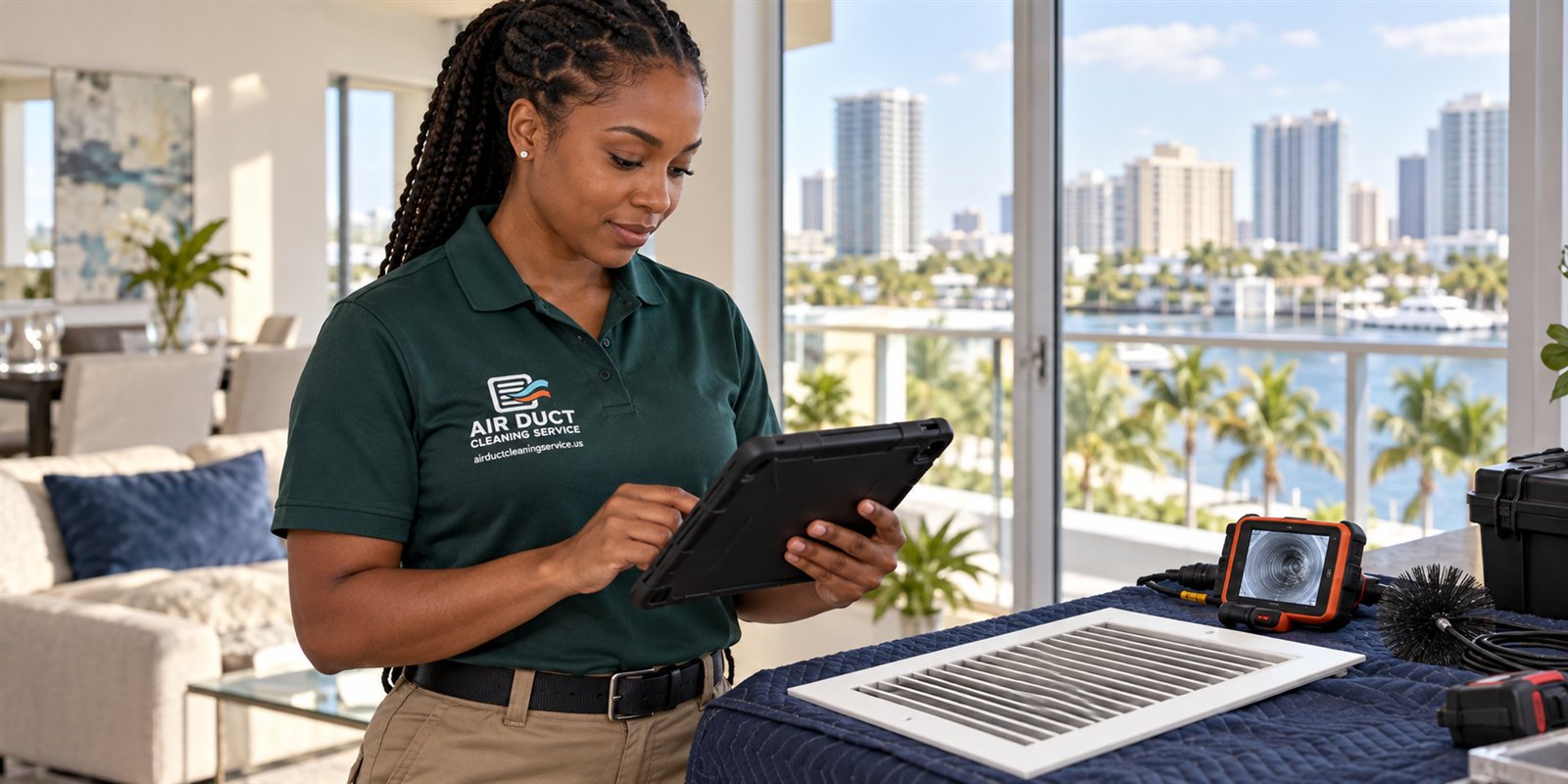
What a condo duct system looks like
Most South Florida condo units have a single air handler in a closet, often near the entry or in a hallway. Short supply ducts run from it through the ceiling or soffits to registers in the living room, bedrooms and kitchen. A return grille, commonly a louvered door or a wall opening on the closet, pulls air back. Some units have two systems, particularly larger ones.
The ducts are usually shorter than in a house. They may be sheet metal, flexible duct or duct board, and they are often hidden behind drywall or a dropped ceiling. That makes access harder than in an attic. Registers and the air handler closet are often the only points where a technician can reach the system.
Because of the small size, a unit can be inspected quickly, but the confined space and building rules can add complexity. Some buildings use a central chilled-water system with a fan coil unit in each apartment instead of a conventional condenser. Know which you have, and tell the provider when you call.

Building rules, associations and permission
Most condo associations have rules about contractors working in units. Typical requirements include insurance certificates from the provider, notice to the management office, limits on working hours and rules about elevators, loading areas and parking. Some buildings require a work permit or an approved vendor list.
Before you schedule, check with your association or property manager. Ask what paperwork is needed, what hours are allowed, where the contractor may park and how equipment is brought in. Having this information ready makes the phone call smoother, and prevents last-minute cancellations.
Landlords and tenants have a role too. If you rent, ask the owner before arranging work, since modifications to ductwork or access panels may require permission. The pages on HOA and condo board duct guide and landlord duct responsibilities explain how responsibilities are commonly divided.
- Insurance certificate for the provider, if the building requires one
- Notice to the management office
- Allowed working hours and days
- Elevator reservation and loading rules
- Parking for the technician's vehicle
- Owner permission if you are a tenant
Closet air handlers and tight access
The air handler closet is the center of the job. These closets are narrow, and the unit often takes up most of the space. Panels may be hard to remove, and the technician may have to work from a kneeling or crouching position. Often the floor is a raised platform with a drain pan underneath, and a secondary drain or float switch may be present.
Clear the closet before the visit. Remove shelves, stored items and anything resting against the unit. Closet air handlers are sometimes used as storage space, which blocks access and creates fire and airflow problems. Keep the return opening clear, since stored items can block the louvers and starve the system.
If the closet is sealed or the unit is hard to reach, tell the provider in advance. A photo helps. The page on air handler cabinet cleaning describes what is done inside the unit once access is available.
Short runs and what that means for cleaning
A small system with short runs is easier to clean in one respect: there is less duct to reach. A technician can often attach collection equipment at the air handler or a main trunk and work out to each register in turn. A condo cleaning therefore tends to be more contained than a house cleaning.
In another respect, it is harder. Short runs are often concealed, and the registers may be the only way in. Each branch may need to be accessed through its register, with tools sized to fit the duct. The technician can see only what the camera or tool reveals, and some sections may be unreachable. This should be recorded honestly.
Dust in a condo comes from the same sources as in a house: filters, lint, household debris and construction. But there are some additional ones. Renovation in a neighboring unit, shared walls and chases that allow air to move between units can all contribute. The page on condo neighbor odor through ducts explains how odors sometimes travel.
Ductless, fan coil and central systems
Not every condo has a conventional ducted system. Some units use ductless mini-split heads on the wall, which have no ducts to clean but do have coils and filters that collect dirt. Others have a fan coil fed by a building water loop. Some older buildings have through-wall units. Each type needs different attention.
If your unit is ductless, duct cleaning does not apply, but cleaning of the indoor head may. The page on mini-split systems and cleaning covers this. If your unit has a fan coil, ask whether the building maintains it, since some associations handle the coil and drain on a schedule.
Knowing the type matters when you call. A provider cannot quote for the wrong system, and a visit planned for ducts will not help a mini-split. Look at the closet or the wall, take a photo of the unit and describe it. The page on ductless versus ducted in condos explains the differences.
Moisture and drain lines in multifamily buildings
Condo units have a drain line that carries condensate from the air handler to a stack or an outdoor drain. In a multifamily building, the drain line may share a path with neighbors, and a clog can overflow into your unit or the unit below. Water damage in a condo tends to affect more than one household, which is why drain maintenance is taken seriously.
If your pan or drain line shows standing water, slime or a sour smell, tell the building manager as well as your service provider. Some associations require unit owners to clear their drain lines on a set schedule. Others do it as a building service. A technician can note the condition, but the maintenance arrangements depend on your building.
Humidity matters too. A unit left closed during a trip, with the system off, can build up moisture and odors. The page on the pre-vacation HVAC checklist explains steps to reduce the risk, and the page on closed-up home and vacancy smells describes what to do if you return to a musty unit.
Dryer vents in condos
Many condo units have a dryer in a closet or laundry nook, with an exhaust that goes through the wall or to a shared riser. These runs may be short but are often complicated by the building. Shared vertical risers carry exhaust from several units, and lint can accumulate in them. Cleaning a shared riser is a building-level job, and individual owners usually cannot arrange it alone.
For the portion inside your unit, a technician can inspect the transition duct, clean the connection and check the wall termination if it is accessible. If your building has a dryer exhaust maintenance program, ask management how it works. The page on dryer vent cleaning and lint removal explains the service, including warning signs and safety points.
If you smell gas or smoke at any time, leave and call 911, and notify the building. Safety in a multifamily building is shared, and a problem in one unit can affect others.
Three condo situations and how they differ
A high-rise owner in Miami Beach has an air handler in a closet off the entry and notices a musty smell whenever the system starts. The building uses a central drain stack. The technician finds a slimy pan and a drain that moves water slowly. Cleaning the pan and notifying management about the drain is the sensible plan. Duct cleaning is secondary, and the inspection photos support the conversation with the association.
A garden-style apartment tenant in Lauderhill sees dusty registers and has a baby at home. The landlord owns the system. The tenant cannot authorize work alone, so the first step is asking the landlord, preferably with photos of the registers and filter. An inspection arranged by the landlord, with a clear report, settles the question without argument.
A snowbird owner in Boca Raton returns after months away to find the unit stuffy, with a faint smell. The system was shut off and the unit closed. Here, humidity and stagnant air likely played the main role. An inspection of the pan, coil and registers comes before any cleaning, and the page on snowbird seasonal home duct guide offers steps to prevent a repeat.
Each situation depends on who owns the system, who maintains the drain and what the building allows. Asking those questions early saves effort and avoids disputes.
Noise, neighbors and scheduling
Equipment makes noise. A collection unit running during a cleaning is loud, and in a condo, sound travels. Be considerate. Schedule within allowed hours, let neighbors know if the building asks you to, and ask the provider how long they expect to be on site. Do not expect a promise of an exact time, since access and conditions vary, but a rough idea is reasonable to ask for.
Parking and hauling equipment can be a bigger challenge in a building than in a house. Elevators, hallways and loading areas need to be arranged in advance. Some buildings require a freight elevator or a specific time slot. A provider that has worked in similar buildings will know to ask.
Protect your unit during the visit. Cover furniture near the registers, move rugs and keep pets and children away. Ask the technician to protect hallway floors if the building requires it.
Filters, access panels and what owners can do themselves
Condo owners can do a surprising amount without opening anything. Check the filter on a regular basis, and replace it with the size marked on the slot. Many condo closets use a return grille on the door with a filter behind it, and it is easy to slide out and look at. A filter that is gray and bowed has been working hard, and one that is clean may mean the system rarely runs.
Look at the floor of the closet for water, and at the drain line for any drips. Smell the air when the system starts. Note any changes in noise. Keep the return louvers clear of storage and keep the closet door closed when the system is running if the return is on the door, since an open door changes airflow.
Do not remove access panels, and do not spray anything into the unit or the drain. If you notice water, a persistent smell or ice on the lines, turn off the system and call for service. In a condo, a small leak can become a shared problem quickly, so report it to management as well.
Keep a small record of what you check and when. A note on the date of the last filter change, a few photos of the closet and a copy of any inspection report make a useful file for future owners, and for an association that may ask about the unit.
Buying, selling and moving into a condo
A condo purchase is a good time to look at the ducts. An inspection of the closet air handler, the filter, the drain and a few registers tells you much about how the system was cared for. For a unit that has been vacant, the case is even stronger. The page on home buyer duct guide explains what to look at and which questions to ask.
Sellers sometimes arrange an inspection too. Photos showing a clean system and a clear drain support a sale. A seller who is unsure about the condition may find an inspection reassuring. See the page on the home seller duct guide for the seller side.
If you are moving in, a visit before your belongings arrive is easier. The rooms are empty, the closet is clear and there is no furniture to cover. The page on moving day duct checklist lists steps that save trouble.
Calling to schedule
When you call, give the building name, the type of system, the location of the air handler and what you have noticed. Mention whether the building has rules about vendors and whether you have checked them. If you are a tenant, say so, and confirm that the owner has agreed.
Quotes are given by phone. A small unit with a clear description can often be discussed quickly, while a unit with unusual access may need an on-site visit, and there is a service call charge explained before dispatch. The page on what happens on the phone call walks through the conversation.
Call when you are ready. Describe your unit and your concerns, and the person on the line can help you decide whether to start with an inspection.
Questions people ask
Do I need the condo association's approval?
Often you do, or at least need to follow its rules for vendors. Buildings commonly ask for insurance certificates, notice to management and limits on working hours. Check with your association or property manager before scheduling, and tell the provider what is required so the visit goes smoothly.
Can ducts in a small condo really get dirty?
Yes. Small systems still collect lint, dust, construction debris and film from humidity. Their short runs are easier to inspect, but they are hidden behind drywall and often reachable only at registers. A camera look through a few registers and the closet shows what condition they are in.
What if my condo has a mini-split instead of ducts?
Then there are no ducts to clean, but the indoor head has a coil and filter that collect dirt. Cleaning applies to those parts. Tell the provider which type you have when you call, so the right service is planned and the visit is not wasted.
Who handles the dryer exhaust in a condo?
It depends on the building. Individual owners are usually responsible for the section inside their unit, while shared risers and rooftop terminations are a building matter. Ask management how your building handles it. A technician can inspect and clean the unit portion, and note issues for management.
Will the noise bother my neighbors?
The collection equipment is loud, so schedule within the building's allowed hours and let neighbors know if the association asks. Ask the provider how long they expect to be on site, understanding that the time depends on access and conditions and cannot be promised exactly.
What should I do before the visit?
Clear the air handler closet, confirm building rules, secure pets and cover nearby furniture. Know where your filter and drain are. If you rent, get the owner's permission. Then call and describe your unit, so the provider can plan the visit and tell you what to expect.
Describe the situation by phone and we will tell you what the job involves. Quotes are given by phone. Jobs that cannot be quoted without seeing them need a technician on site, and the service call charge is explained on the phone before anyone is dispatched.
Related pages
- Air Handler Cleaning: The air handler cabinet, drain pan area and filter slot as a distinct job from the ductwork itself, and what a careful cabinet cleaning includes.
- Dryer Vent Cleaning: Why long vent runs and rooftop terminations in Florida homes collect lint, what clearing a dryer exhaust involves, and the warning signs worth acting on.
- Ductless or Ducted: How ducted and ductless cooling differ in condos and apartments, what upkeep each needs, who is responsible, and where duct cleaning does and does not apply.
- HOA and Boards: What HOA and condo boards should know about duct work: common elements versus unit responsibility, choosing vendors, notices, records and avoiding disputes.
- Treatments: Sprays, fogs and coatings are often offered with duct cleaning. Learn what they are, why they are optional and which questions to ask before saying yes.
- Evaporator Coil: Why the cooling coil is the dampest part of an air system in humid Florida, how it is inspected and what coil cleaning can and cannot do for comfort.